Suggestions on Writing an Essay Debating Photograhy as an Art
How Photography Became an Art Form
Can Computers Create Art? Part 1
This is the starting time function of a series of posts on the topic of whether computers tin create art, adapted from my longer essay on that topic . For lessons from the past about AI and art, perhaps no invention is more pregnant than photography. This first essay addresses the question: How did photography become respected as an art form, and what lessons does this hold for new artistic AI technologies?
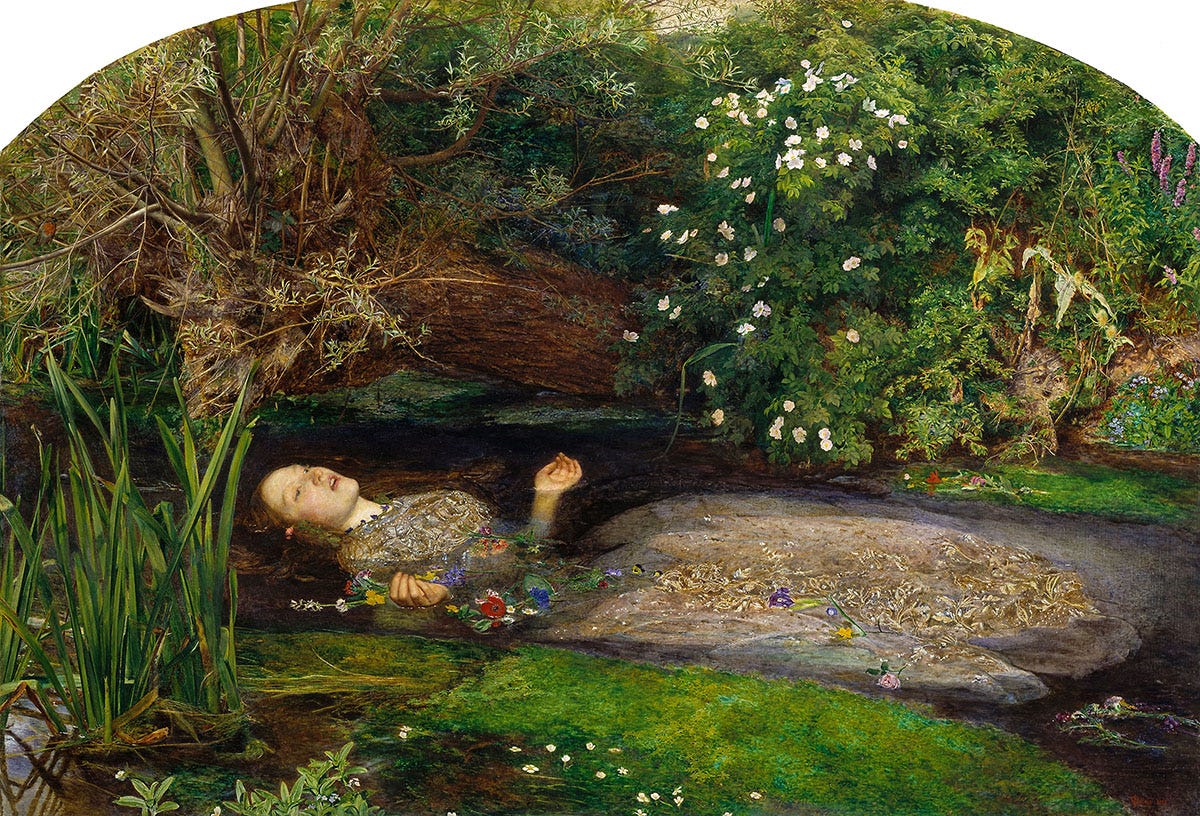
Prior to the invention of photography, realistic images of the world could just be produced by skilled artists. In today'south world, we are so swamped with images that it is hard to imagine but how special and unique it must have felt to see a well-executed realistic painting. And the skills of professional artists had steadily improved over the centuries; by the 19th-century, artists such every bit the Pre-Rafaelites and the French Neoclassicists have achieved dazzling visual realism in their work.
The technical skills of realism were inseparable from the other creative challenges in making images. This changed when photography automatic the task of producing images of the existent world.
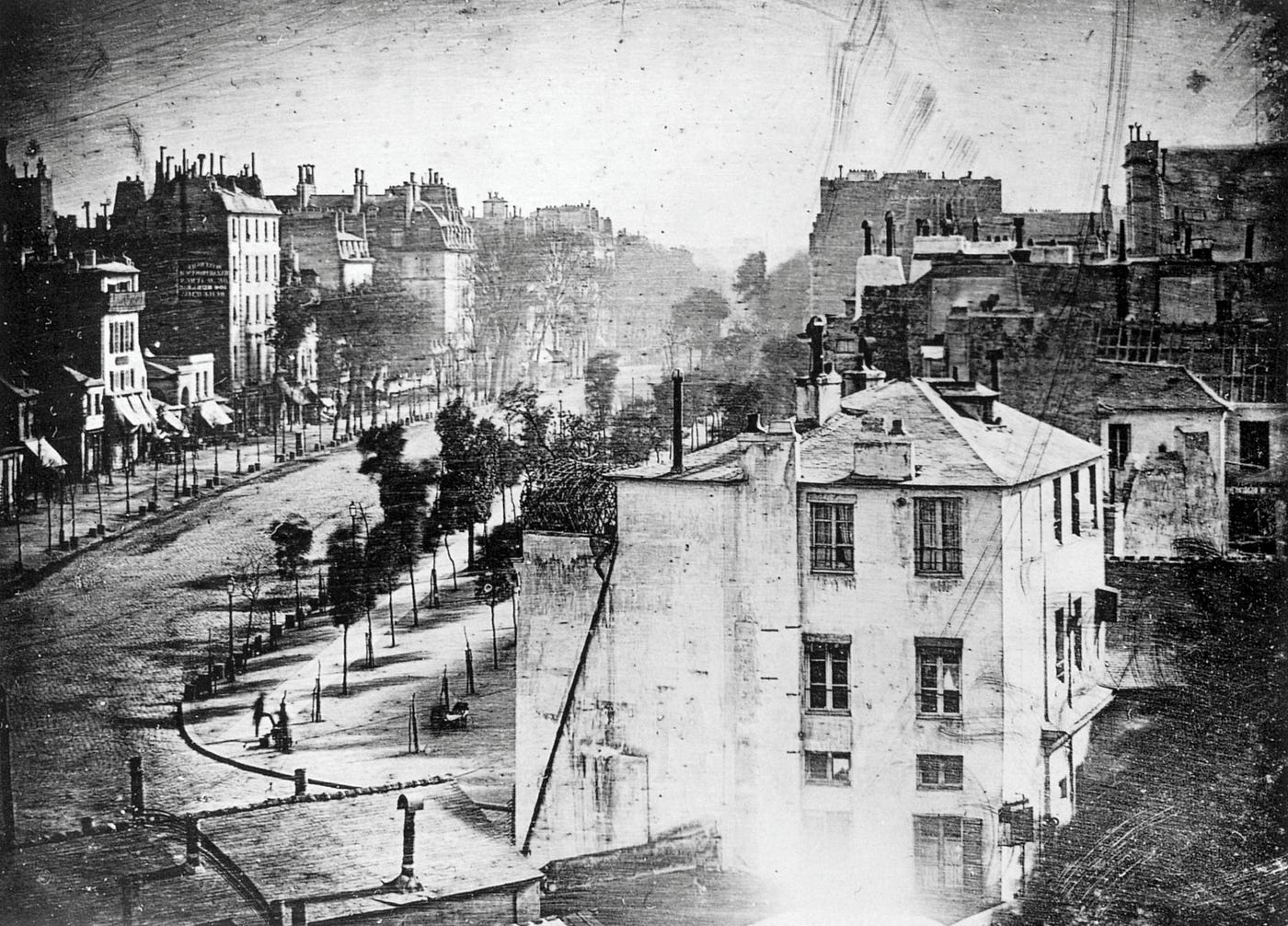
In 1839, the first two commercially-practical photographic processes were invented: Louis-Jacques-Mandé Daguerre's daguerreotype, and William Henry Fox Talbot'south negative-positive procedure. They were mainly presented as ways to produce applied records of the world. Of the two, the daguerreotype was more pop for several decades, largely because Talbot's process was restricted by patents. Improvements to Talbot's method eventually made the daguerreotype obsolete and evolved into modern pic processes.
Portraiture and Other Practical Uses
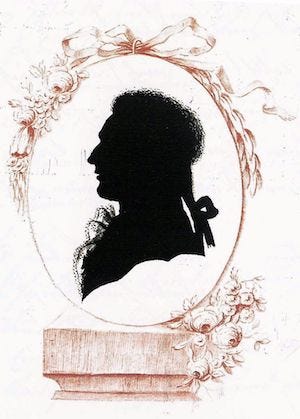
Portraiture was a main driver for early on adoption of cameras. Then, equally today, people enjoyed possessing pictures of their friends, loved-ones, and ancestors. Portrait painting was only available to aristocrats and the very wealthy. In the 18th century, several inexpensive alternatives were developed, such as the silhouette, a representation of an individual's outline, typically mitt-cut by an artisan out of black paper.
The daguerreotype offered an economical way to create a realistic portrait. It was very slow and required locking the field of study's head in place with a caput brace for several minutes, while the subject tightly gripped their chair, so as not to move their fingers. Nonetheless, numerous daguerreotype studios arose and became commonplace as technologies improved, and many portraitists switched to this new technology.
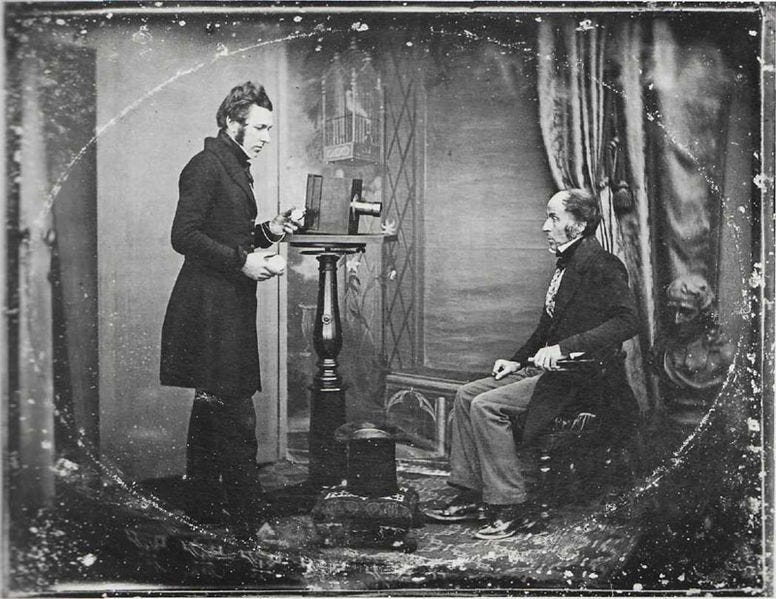
Within a few decades, photography largely replaced near older forms of portraiture, such as the silhouette, and, today, no one seems to particularly regret this loss. As much equally I capeesh the mystery and beauty of old etchings and portraits, and even some current portraiture, I'd ordinarily rather use my mobile telephone camera than to try to paint everything by hand.
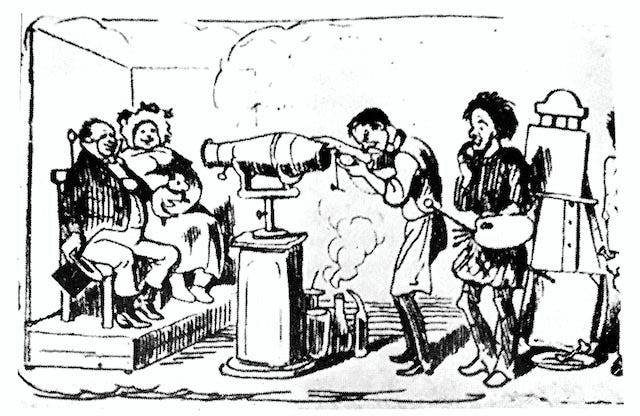
Another early use for the daguerreotype was to produce souvenirs for tourists: by 1850, daguerreotypes of Roman ruins completely replaced the etchings and lithographs that tourists had previously purchased. As the engineering science improved, photography became indispensable as a source of records for engineering projects and disappearing architectural ruins, equally well equally for documentary purposes, such as Matthew Brady'due south photographs of the horrors of the American civil state of war.
"Is Photography Art?"
Artists and critics debated for many decades whether photography is art. Three main positions emerged.
Outset, many people believed that photography could not be art, because it was made by a auto rather than by human creativity. From the starting time, artists were dismissive of photography, and saw it as a threat to "existent art.'' Even in the first presentations of 1839, classical painter Paul Delaroche is reported to take blurted out "From today, painting is dead!" Two decades later, the poet Charles Baudelaire wrote, in a review of the Salon of 1859:
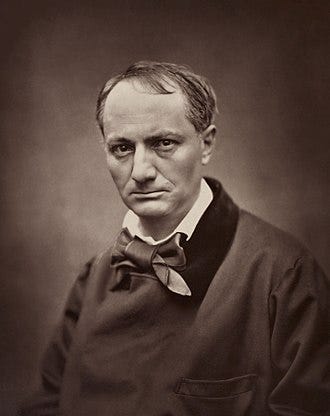
"If photography is allowed to supplement art in some of its functions, it will soon supersede or decadent it altogether, cheers to the stupidity of the multitude which is its natural ally.''
A 2d view was that photography could be useful to existent artists, such equally for reference, merely should not be considered as equal to drawing and painting. For example, despite his public denunciation of photography, Ingres' later on paintings show considerable bear witness that he worked from photographic reference.
Finally, a tertiary group, relating photography to established forms like carving and lithography, felt that photography could eventually be as pregnant an art grade as painting. This group, including hobbyists and tinkerers, avidly explored its potential.
The Effect of Photography on Fine art
Photography ultimately had a profound and unexpected effect on painting. Painters' mimetic abilities had been improving over the centuries.
Many painters of the 19th century, such as Pre-Raphaelites like John Everett Millais and Neoclassicists like Ingres, painted depictions of the world with dazzling realism, more than had ever been seen before. Nevertheless, cameras became cheaper, lighter, and easier to utilize, and grew widespread among both amateurs and professionals. Realistic photographs became commonplace by the cease of the 19th century. If photorealism could be reduced to a mechanical procedure, and so what is the artist'southward role?
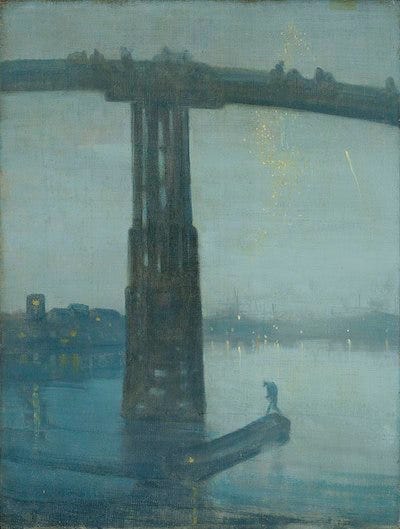
This question drove painters away from visual realism and toward different forms of abstraction. James McNeill Whistler's Tonalist movement created atmospheric, moody scenes; he wrote: "The imitator is a poor kind of creature. If the man who paints only the tree, or the blossom, or other surface he sees before him were an artist, the male monarch of artists would exist the lensman. Information technology is for the creative person to practise something beyond this." The Impressionists, who sought to capture the perceptions of scenes, were likely influenced past the evocative "imperfections'' of early photographs like the Boulevard du Temple, shown above.
In contrast, Symbolists and post-Impressionist artists moved away from perceptual realism altogether. Edvard Munch wrote "I accept no fear of photography as long as it cannot be used in heaven and in hell. … I am going to paint people who breathe, feel, beloved, and suffer.'' Vincent Van Gogh, describing his artistic breakthroughs around 1888, wrote to his brother:
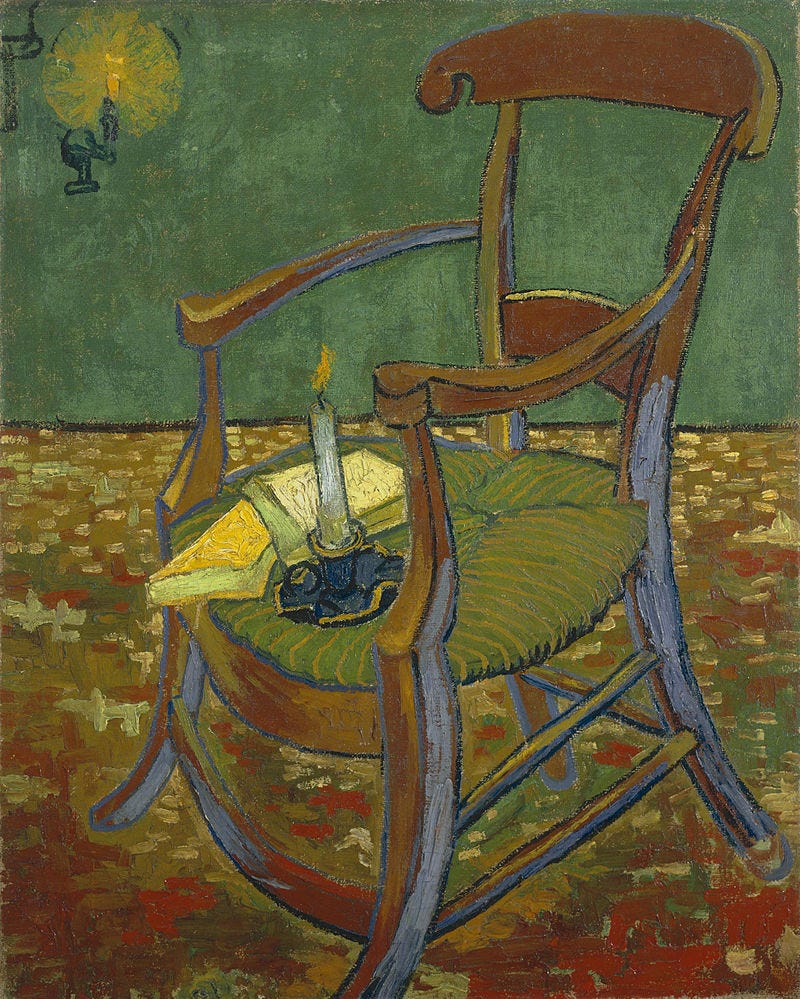
You must boldly exaggerate the effects of either harmony or discord which colors produce. It is the aforementioned thing in drawing — accurate cartoon, accurate colour, is perhaps not the essential affair to aim at, considering the reflection of reality in a mirror, if it could exist defenseless, color and all, would not be a pic at all, no more than a photograph.
In other words, Munch, Van Gogh, and many other artists of their generation viewed realism as the task of photography, and the goal of the real artist was to find a mode to go beyond realism—to exercise something that cameras could not exercise.
In 1920, many decades later, André Breton, a founder of Dada and Surrealism, prefaced a statement on Dada with: "The invention of photography has dealt a mortal accident to the onetime modes of expression, in painting also as poetry. … Since a blind instrument now assured artists of achieving the aim they had set themselves upwards for … they at present aspired … to pause themselves of the imitation of appearances."
It seems likely, in fact, that photography was one of the major catalysts of the Mod Art move: its influence led to decades of vitality in the earth of painting, as artists were both inspired by photographic images and pushed beyond realism. Without photography, mayhap modernistic art would never have existed.
Pro-Photography Movements
Meanwhile, photographers attempted to develop and abet for their own fine art grade. In the Usa, these photographers called themselves the Photo-Secessionists, since they "seceded" from custom and traditional forms of fine art. They argued that the artist's considerable control over the paradigm cosmos, to express their vision, made information technology an art form.
The Pictorialist movement, begun effectually 1885, pursued a particular visual aesthetic in the creation of photographs as an art form. Pictorialists exercised considerable artistic control over their photographs. Some used highly-posed subjects as in classical painting, and advisedly manipulated their images in the darkroom to create very formal compositions. Many of their works had hazy, atmospheric looks, similar to Whistler'due south Tonalism, softening the realism of high-quality photography. They seemed to be deliberately mimicking the qualities of the fine art painting of the time, and today much of their piece of work seems rather affected.
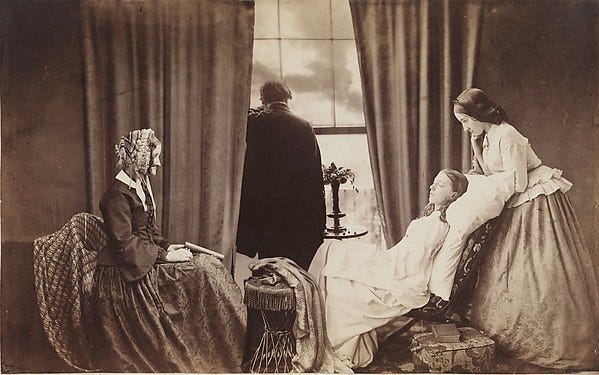
The Photo-Secessionists pursued various strategies toward legitimization of their work as art, such as the organization of photographic societies, periodicals, and juried photography exhibitions. Their works and achievements made information technology harder and harder to deny the creative contributions of photography; culminating in the "Buffalo Show," organized by Alfred Stieglitz at the Albright Gallery in Buffalo, NY, the start photography exhibition at an American fine art museum, in 1910. Photography was firmly established equally an art.
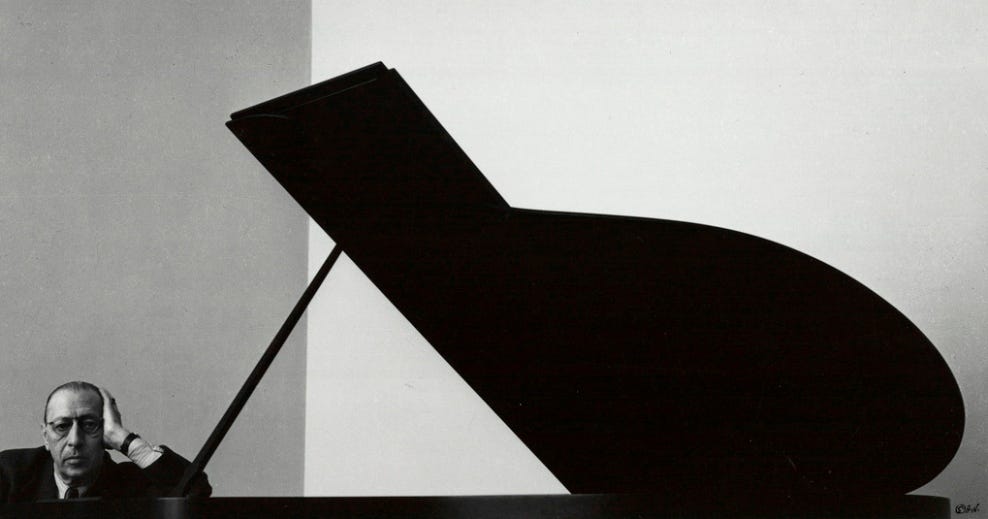
Subsequent Modernist photography movements shed the artificial styles of Pictorialism. This included photographers similar San Francisco's Grouping f/64, who explored combined sharp-focused, naturalistic imagery with abstracted compositions.
Lessons for AI and Art
This story provides several lessons that are direct relevant to AI as an creative tool.
When the photographic camera was commencement invented, it looked similar a machine that automated the cosmos of fine art. No skill was required. Many artists feared and disparaged information technology. They predicted that information technology was going to destroy high-quality art and put the best artists out of work.
What actually happened?
- A new art form was created: photography. This form has its own unique styles and creations.
- Old art forms were reinvigorated. Perhaps modern art would non exist at all, had photography not raised questions nearly the creative person'due south part in realism.
- Old portraiture technologies became largely obsolete. In practice, this meant that portrait studios needed to learn and adopt the new technology.
- Photography became available to hobbyists; paradigm-making was "democratized." Nowadays, anyone with a mobile phone can take a picture.
This blueprint repeated with the invention of estimator graphics. In the early days of computer graphics, Ed Catmull and Alvy Ray Smith (who afterward founded Pixar), tried to interest Disney animators in the new engineering science. Smith later said "Animators were frightened of the computer. They felt that it was going to have their jobs away. We spent a lot of fourth dimension telling people, 'No, it'south merely a tool — information technology doesn't practice the inventiveness!' That misconception was everywhere." Today, estimator blitheness is an enormously successful new art form, and it relies on the talents of vast numbers of animators and other artistic and technical professionals.
I believe that the same pattern is repeating itself with the new artistic AI tools. Naive spectators, who exercise not understand current AI technology or fine art (or both), worry that AI volition make artists obsolete. Don't believe the hype. In fact, these new tools open enormous creative opportunities for art and civilization; they exercise not replace artists simply, instead, empower them.
I explain more in the next function of this series.
References
The historical data in this essay is primarily distilled from 2 books: A Earth History of Photography, past Naomi Rosenblum, for full general history, and Art and Photography, by Aaron Scharf, for the coaction of painting and photography. The Alvy Ray Smith quote is from The Story of Pixar, past Karen Paik.
This essay is adapted from a longer essay that I have published in the journal Arts.
Source: https://medium.com/@aaronhertzmann/how-photography-became-an-art-form-7b74da777c63

Post a Comment for "Suggestions on Writing an Essay Debating Photograhy as an Art"