Budget proposal is mixed for foster students
Neil Hanshaw for EdSource
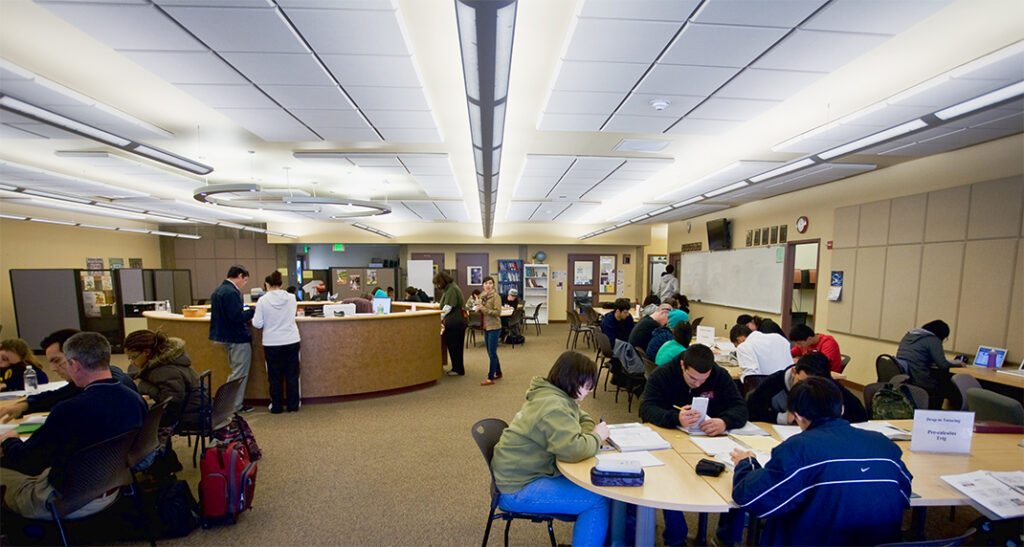
Students study at De Anza Higher.
 Neil Hanshaw for EdSource
Students study at De Anza College.
In the revised May budget, Gov. Jerry Chocolate-brown proposes funding a plan to aid foster youth who are attending community college. But he does not phone call for increasing funds to a service that helps Chiliad-12 students exist successful in school, equally foster youth advocates had hoped.
The governor wants to fully fund a supplemental component for foster students of the Extended Opportunity Programs and Services program, which provides state funds for low-income customs college students. Foster youth and old foster youth under the historic period of 26 could receive these services even if they took only nine units a semester instead of the 12 units required under Extended Opportunity Programs and Services.
Although advocates for foster youth say they are excited that the governor is funding the new program for community college students, they are disappointed that he did not increase funds to expand Foster Youth Services, a program that provides counseling, tutoring and other support for K-12 students.
The supplemental funding could be used to provide academic, career and mental wellness counseling; to monitor academic progress; and to requite tutoring and mentoring back up. Funds could likewise exist used to teach independent living skills and for housing assistance, child care, transportation, books and supplies.
Although advocates for foster youth say they are excited that the governor is funding the new programme, they are disappointed that he did not increase funds to aggrandize Foster Youth Services, a program that provides counseling, tutoring and other support for G-12 students. Currently only foster students living with non-relatives have access to the services, even though an estimated 3rd to more than half of foster youth live with relatives. Those relatives, often grandparents, are typically low-income and cannot afford the counseling and tutoring the foster children need, advocates say.
Advocates are calling for an increase of $20 million to $30 million a year so the services would be available to all foster youth. Assemblywoman Shirley Weber, D-San Diego, is proposing that extension of services in Assembly Beak 854. Foster Youth Services currently gets $15 million each year.
"Access to those services is critical," said Marcus McKinney, senior assistant to Weber, when the bill was being introduced. "We need to value relatives and get them a reasonable amount of resource."
Jackie Thu-Huong Wong, director of the advocacy grouping FosterEd in California, said the governor's proposal for community colleges should lead to more than students matriculating into college and transferring to four-twelvemonth universities. But by not including additional funds to make Foster Youth Services inclusive, the governor is not acknowledging the key function played by the programme in helping districts support foster students and then they tin be gear up for higher, she said.
Under the Local Control Funding Formula, districts are expected to develop specific proposals to aid their foster students succeed in schoolhouse. Only many districts lack the expertise to deal with this population of students, who have suffered abuse and fail and often have been shuffled from home to home and schoolhouse to school. Studies have shown that foster students accept poor academic outcomes and are the least likely subgroup of students to graduate from high school. They also have low college completion rates.
The plan supported past the governor'south proposed budget is aimed at improving those completion rates. College districts have to apply to the California Community Colleges Lath of Governors for the supplemental funds. Up to ten community college districts, out of 72 districts in the state, can set upward the supplemental fund, with priority existence given to districts with the highest number of eligible students. Colleges that receive funds must submit a biennial report describing their efforts to serve foster students.
Each yr, more than 4,000 foster youth are emancipated or "age out" of the foster care system when they turn 18. Nether a new police that took effect concluding year, foster youth tin continue in the arrangement upwardly to age 21 if they meet certain conditions. One of those atmospheric condition is existence enrolled in a postsecondary or vocational instruction institution.
If approved in the final budget, the allocation would fulfill the promise of Senate Bill 1023, which established the supplemental component. The beak, authored by Sen. Carol Liu, D-Glendale, was passed by the Legislature last twelvemonth and signed into law in September.
On Wednesday, a Senate budget subcommittee voted unanimously to approve funding the program. The committee amended the governor'due south budget bill language to ensure that up to $15 one thousand thousand of the Community College Student Equity funds be used to support foster youth and former foster youth.
The budget subcommittee "added teeth" to the revised May budget proposal, said Tim Morrison, senior policy associate with the advocacy group Children Now. "They went to a higher place and beyond the governor's language," he said.
To get more reports like this 1, click here to sign upward for EdSource's no-cost daily email on latest developments in teaching.
Source: https://edsource.org/2015/budget-proposal-is-mixed-for-foster-students/80096

Post a Comment for "Budget proposal is mixed for foster students"